Go Your Own Way: Buckingham's Breakup Song Explained
Go Your Own Way is Fleetwood Mac's breakup song, and Lindsey Buckingham wrote it about a bandmate.
It was the lead single from Rumours, released in December 1976.
It peaked at number 10 on the Billboard Hot 100 and reached number one in the Netherlands and Belgium.
This page covers how it was written, how it was recorded, how it charted and who has covered it since.

Fleetwood Mac in a 1977 Rumours advertisement.
Image credit: Warner Bros. Records, public domain, via Wikimedia Commons (Billboard, June 25, 1977).
Go Your Own Way: Written About a Bandmate
Most breakup songs are written alone and mailed away, but this one had to be rehearsed with its subject.
A Haunted Rental in Florida
Wikipedia says Buckingham wrote the song at a rented house in Florida, between legs of the Fleetwood Mac tour.
It was the first song he brought to the Rumours sessions.
Drummer Mick Fleetwood remembered the house as having a bad, haunted feel.
Buckingham described the writing as a stream of consciousness built on raw emotion.
Engineer Ken Caillat has said he was unsure the song had potential when he first heard the demo.
The Line Stevie Nicks Wanted Gone
Early versions had a different chorus, and they did not yet include the line about "packing up, shacking up."
Wikipedia says Stevie Nicks asked Buckingham to remove that line, because it implied she wanted to be with other men.
He kept it, and Nicks has said he wrote it to provoke her.
In a 2022 New Yorker interview, Nicks called this song and her own "Dreams" counter songs, two views of the same breakup.
Her side of the story has its own page, Dreams Fleetwood Mac.
Sheryl Crow has said she felt the song was written for her when she was seventeen.
Recording the Rumours Single
The song took about four months to develop, across three studios in 1976.
Three Studios, Three Producers
Wikipedia credits the production to Fleetwood Mac, Richard Dashut and Ken Caillat.
Sessions took place at these studios.
- The Record Plant in Sausalito, California.
- Wally Heider's Studio 3 in Hollywood.
- Criteria Studios in Miami.
How the Sound Was Built
Buckingham based the drum feel on the groove of the Rolling Stones' "Street Fighting Man."
Mick Fleetwood played across the toms and hit the bass drum on the middle beat, which gives the song its tumbling gallop.
John McVie's first bass part was busier, so Buckingham asked for straight eighth notes on the verses and more freedom on the choruses.
Buckingham tracked early guitar on a 1959 Fender Stratocaster.
Later he layered a distorted electric guitar over a cleaner one, so the rhythm guitars read as a single instrument.
Christine McVie played Hammond organ and sang backing vocals.
The acoustic guitar went on late in the process.
The Spliced Guitar Solo
Buckingham struggled with the solo, so Caillat finished it at Criteria in Miami.
He spliced together six lead-guitar takes by working the faders, according to Wikipedia.
A Shure SM57 microphone captured the solo.
Dashut said the kick drum and the compressed rhythm guitar produced a pumping effect that might not have happened in a digital mix.
The Single at a Glance
Warner Bros. rushed the record out early to catch the US Christmas market in 1976.
Album pre-orders reached 800,000, which Wikipedia describes as reportedly the label's largest advance sale at the time.
| Detail | Fact |
|---|---|
| Artist | Fleetwood Mac |
| Writer and lead vocal | Lindsey Buckingham |
| Producers | Fleetwood Mac, Richard Dashut, Ken Caillat |
| US release | December 20, 1976, on Warner Bros. Records |
| UK release | February 11, 1977 |
| Album | Rumours (1977), the band's eleventh studio album |
| Length | 3:43 (the US vinyl listing gives 3:34) |
| B-side | Silver Springs (4:33) |
Source: Wikipedia article on the song, checked October 23, 2026.
Here is the music theory in two lines.
- The verses move through I, V and IV chords.
- The chorus moves through vi, IV and V.
You can also hear Go Your Own Way on the Listen Now jukebox.

Stevie Nicks in a 1977 promotional photograph.
Image credit: Photo by David Wainwright, public domain, via Wikimedia Commons.
Hear the Original Recording
Press play to hear the song from the 1977 Rumours era.
On the Charts: A Top 10 Hit Across the Atlantic
Go Your Own Way did not reach number one in the United States.
It did reach number one in the Netherlands and Belgium.
The Billboard Hot 100 Run
The single debuted at number 71 on the Hot 100 dated January 8, 1977.
It peaked at number 10 on March 12, 1977, and held there for two weeks, according to Wikipedia.
It spent 11 weeks in the top 40.
Rumours would soon supply the band's first number one with "Dreams" in June 1977, according to this site's weekly Hot 100 data.
This single is also the 94th entry on our top songs of 1977 countdown.
To pull another 1977 hit at random, spin the Random 70s Song Generator.
Chart Peaks Around the World
| Chart | Peak |
|---|---|
| Netherlands Dutch Top 40 | No. 1 |
| Netherlands Single Top 100 | No. 1 |
| Belgium (Flanders) | No. 1 |
| South Africa (Springbok Radio) | No. 4 |
| US Radio & Records Top 40 | No. 8 |
| Belgium (Wallonia) | No. 9 |
| US Billboard Hot 100 | No. 10 |
| US Cash Box Top 100 | No. 10 |
| US Record World | No. 10 |
| Canada Top Singles (RPM) | No. 11 |
| West Germany (GfK) | No. 11 |
| Australia (Kent Music Report) | No. 20 |
| New Zealand | No. 23 |
| UK Singles | No. 38 |
| US Adult Contemporary (Billboard) | No. 45 |
Source: Wikipedia article on the song, weekly charts section, checked October 23, 2026.
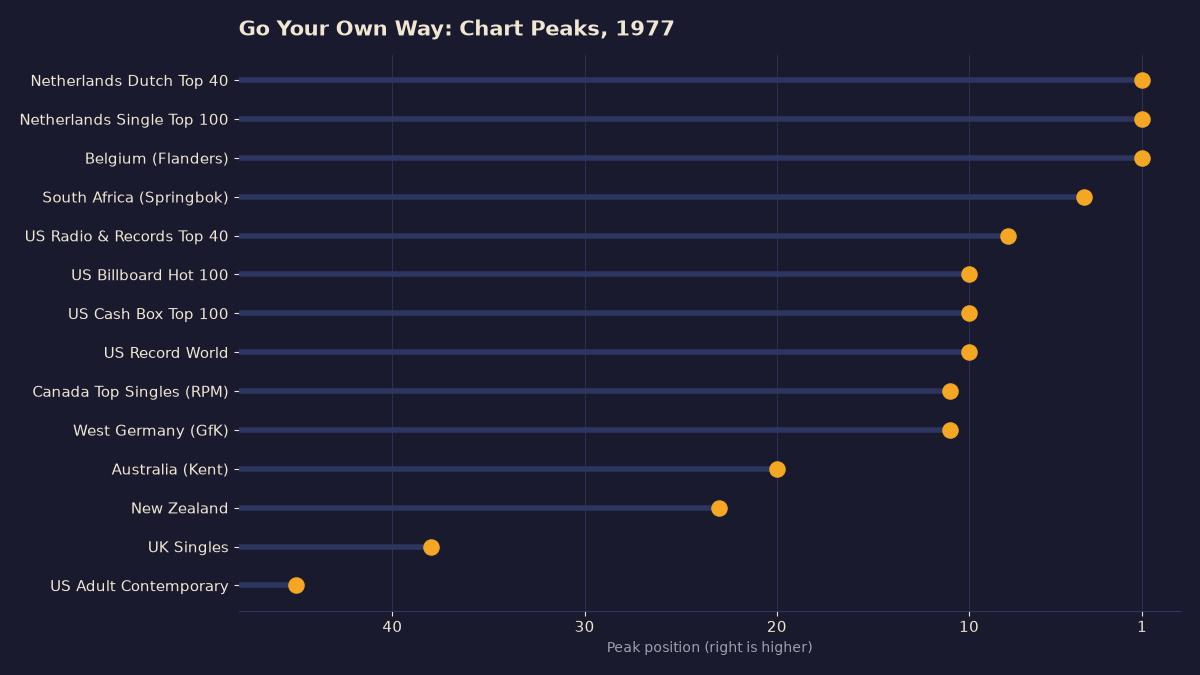
Fourteen of the song's chart peaks, drawn from the Wikipedia figures in the table above.
Year-End Standing
Wikipedia reports these 1977 year-end positions.
- US Billboard Hot 100: No. 94.
- US Cash Box: No. 86.
- US Radio & Records Top 40: No. 45.
- Netherlands Dutch Top 40: No. 7.
- Netherlands Single Top 100: No. 6.
- Belgium (Flanders): No. 17.
- Canada: No. 109.
The song has also come back on later year-end lists, at No. 91 in the UK for 2023 and No. 94 in the UK for 2025.
Certifications
- United Kingdom (BPI): 6x Platinum, for 3,600,000 units.
- New Zealand (RMNZ): 11x Platinum, for 330,000 units.
- Denmark: Platinum, for 90,000 units.
- Italy: Gold, for 50,000 units.
- Spain: Gold, for 30,000 units.
Wikipedia notes the UK figure combines sales and streaming.
Critics and the Live Show
What Critics Said
The Washington Post's Alex Ward called it the best single choice on the album when it came out.
Billboard said it fit mainstream rock better than anything on the band's 1975 album, and compared it to Jefferson Starship.
Bud Scoppa called it a "pathos-laden scorcher."
Later lists have been just as kind.
- Rolling Stone ranked it No. 120 on its 500 Greatest Songs list in 2010, and No. 401 in 2021.
- NME put it at No. 33 on its 50 Most Explosive Choruses list in 2012.
- It is on the Rock and Roll Hall of Fame's 500 Songs that Shaped Rock and Roll list.
- It was nominated for the 1978 Grammy for Best Vocal Arrangement for Two or More Voices, and lost to the Eagles' "New Kid in Town."
Closing Out Fleetwood Mac Shows
The band first played it live on the 1977 Rumours Tour, more than 100 times.
It was played at every stop on the Tusk Tour, and a Cleveland recording appeared on the 1980 album Live.
Wikipedia says it was the main set closer on The Dance tour in 1997, and again the last song of the main set in 2003 and on the 2013 tour.
The only time the band played it without both Buckingham and Nicks was the 1994 to 1995 tour.
For the rest of the story, head to Music of the 70s and keep browsing.
Covers and Later Uses
The song has had a second life through other singers and screens.
- The Cranberries recorded a version for the 2002 Complete Sessions release of To the Faithful Departed.
- Wilson Phillips put a new version on their 2004 reunion album California, which reached No. 13 on the Billboard Adult Contemporary chart.
- Lea Michele sang it on Glee in 2011, and that version peaked at No. 45 in the US and No. 51 in the UK.
- Lissie's 2012 version appeared on the Safe Haven soundtrack and in A Discovery of Witches.
- Ben Platt and Aly & AJ performed it on Platt's Reverie Tour and on Dick Clark's New Year's Rockin' Eve in 2023.
- A 2025 PayPal campaign with Will Ferrell used an altered version.
Source: Wikipedia article on the song, covers and media section.
For more of the band's catalog, see all of our Fleetwood Mac songs, the story of Rhiannon, or our guide to 70s rock.
Frequently Asked Questions
Who wrote Go Your Own Way?
Lindsey Buckingham wrote Go Your Own Way for Fleetwood Mac, and Wikipedia says it addresses his breakup with bandmate Stevie Nicks.
He wrote it at a rented house in Florida between legs of the band's tour.
It was the first song he brought to the Rumours sessions.
What number did Go Your Own Way reach on the Billboard Hot 100?
Go Your Own Way peaked at number 10 on the Billboard Hot 100 on March 12, 1977, and stayed there two weeks, according to Wikipedia.
It debuted at number 71 on the chart dated January 8, 1977.
It was not a number one, and it ranked 94th on the 1977 year-end Hot 100.
What is the line Stevie Nicks disliked in Go Your Own Way?
Stevie Nicks objected to the line about packing up and shacking up, which implied she was seeing other men.
Wikipedia says she asked Buckingham to remove it, but he kept it.
Nicks said he wrote the line to provoke her, and in 2022 she called this song and Dreams counter songs.
Was Go Your Own Way the first single from Rumours?
Go Your Own Way was the lead single from Fleetwood Mac's album Rumours.
Warner Bros. released it in the US on December 20, 1976, and in the UK on February 11, 1977.
The B-side was Silver Springs, a Stevie Nicks song that was left off the original album.
Who has covered Go Your Own Way?
Go Your Own Way has been covered by the Cranberries, Wilson Phillips, the cast of Glee and Lissie, among others.
Wilson Phillips reached number 13 on the Billboard Adult Contemporary chart in 2004, and Lea Michele's Glee version peaked at number 45 in the US.
Ben Platt and Aly & AJ have also performed it.
Sources
- "Go Your Own Way", Wikipedia, for the writing story, the Nicks lyric dispute, the recording and production details, the release dates and B-side, chart peaks, year-end positions, certifications, critical reception, live history and covers.
- Rumours (album), Wikipedia, for the album the song appears on.
- Fleetwood Mac, Wikipedia, for background on the artist.
- The Hot 100 year-end rank of 94 and the June 1977 first number one for "Dreams" come from this site's own year-end and weekly Hot 100 data.
Related Posts

Dreams Fleetwood Mac: Written in 10 Minutes, Alive in 2020
Dreams Fleetwood Mac took Stevie Nicks 10 minutes to write and one week at number one. How it was recorded and why a 2020 skateboard video revived it.
Read post
Rhiannon Fleetwood Mac: A Novel, a Myth and a Trance
Rhiannon Fleetwood Mac began with a novel character, not a myth. Stevie Nicks on the name, the studio splices, the 1976 charts and the live trance.
Read post
Fleetwood Mac Songs: 9 Hits Played, 1 at Number One
Fleetwood Mac songs: play all 9 hits of the 70s, from Over My Head to Sara.
Read post